
I was working from home with a terrible head cold that I picked up somewhere. Since I was obviously carrying something that could hurt the people around me, I opted to stay away. While sipping my third cup of tea and working through the second box of tissues I browsed through my notes from a conference and took a rest on the sofa. They were full of great ideas on what to do next and where to take things from here. So I decided to turn the ideas into tracked issues.
Still on the sofa, thinking about getting a fourth cup of tea, ignoring the unread messages, I started sorting through them. In the end, less than half of them survived into something useful. That little commentary track that lives in my brain popped up and asked “Is this due to my busy working immune system killing off both germs and ideas, or is this how ideation actually works?”
That is a good question. Did the cold make me kill good ideas? I took a swing at the ideas that were still on the list and in the end, that list got even shorter. This is what I came out with.
One Banana, Two Bananas, Critical Mass Bananas
All radioactive isotopes have a half-life. Uranium-238 is 4.5 billion years and Carbon-14 is 5,730 years. That makes the latter one good to date old things, like a Viking. It is worthless to date wine, so for that Tritium with a half-life of 12.3 years is a lot better.
The thing with a half-life is that it is just that. It continues to just cut itself in half and never really disappears. Like the last cake at a Swedish fika. No-one ever takes the last piece, and I still think that the first splitting of an atom was done at a fika in a Swedish research laboratory.
Bananas contain a measurable dose of radiation from potassium-40. The science folk in that Swedish laboratory actually use it. Ideas are like bananas. Some are full of caesium-137 if they grew near Chernobyl. Lots of radiation that never dies, but not in a good way. Bad banana, bad idea. Still around after 60 years of refinement.
Pile up enough normal bananas in one place and you will get a chain reaction. A conference, an ideation workshop, a one-week course on the latest and hottest model. They are all a pile of bananas. You fly home with a lethal dose of idea-radiation.
If the first thing you do is go to your issue tracker and start piling up the stories, the backlog will reach a critical mass and you get a total meltdown.
Your Geiger counters
Hot is the literal word that is used to describe radioactive material. A fresh idea is also hot, and if they come in mass: ideation poisoning. This is where you need to make ideas less hot.
Letting time pass is one way to do it. It is okay to radiate enthusiasm when coming back to work, but keep the ideas locked in the lead box for a couple of days.
Trust your gut-feeling. If you still believe in this idea after coming back to it, you might be on to something. Also trust your peers’ gut-feelings. If they wince or twitch uncomfortably when you mention your idea again, it is possible it still has way too high radiation.
Radiation keeps halving while you sleep, but you can’t speed up the decay. Ideas don’t really work that way. You have to decay them by iterating over them. Each iteration is a half-life, but unlike uranium, you control how fast the clock ticks.
When we are at a conference, we gather all this material and bring it home with us. Half-life is about how hot and dangerous a material is, but it is measured in time. The half-life of an idea is measured in iterations. I realised this, and this blog idea was about to be scrapped.
But then I had to de-compress my clogged sinuses, and the blog was still alive.
Deep dive
Divers that stay at depth for a long period have to stop several times on their way up to decompress and let the body take care of dangerous gas buildups, or they will get decompression sickness. It is all about how fast you surface. The idea can be perfectly cool and carry no radiation at all, but if you bring it up too fast, everyone gets the bends.
When coming back from somewhere that has filled you with ideas, you have been deep for a long time. You have been immersed, in the zone, lots of context dissolved in you and your whole body fizzles. You have been at 38 meters breathing nitrox-32 for a week. (I know that it is impossible.)
Your colleagues are still at surface level, breathing normal air.
Bringing an idea directly to the surface is what triggers that thousand-yard stare on the demo, the complaints from customers who don’t understand the new feature, and the developer-bends.
How do you handle this strange device that is a dive computer stuck to a Geiger counter in a box of bananas?
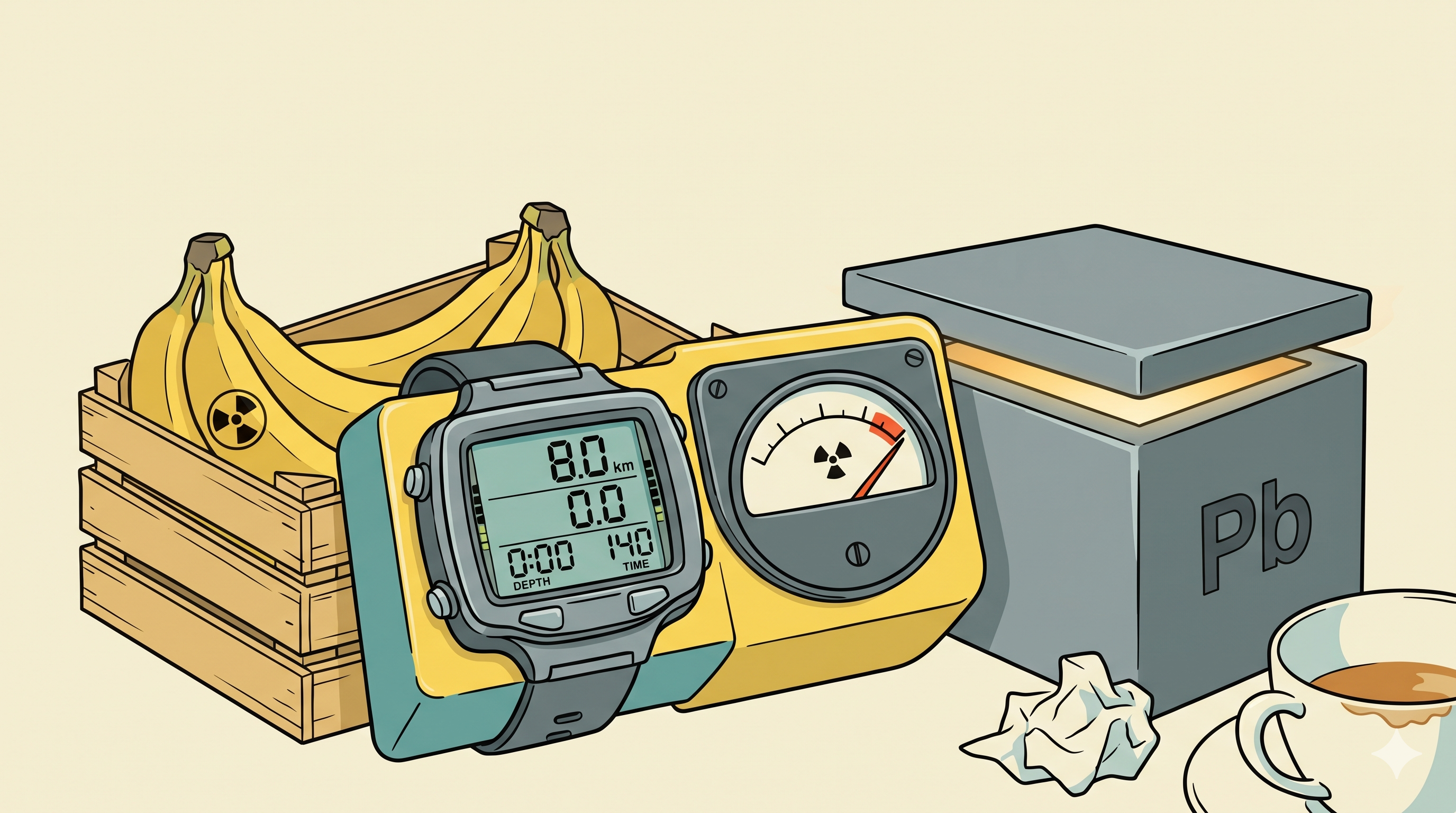
You have to decompress. Your job when you handle ideas is to make a staged ascent. Your self-check is one. The team gut-check is the next. Then spike it, prototype it, do a limited rollout, and finally surface it and show it to the customer. Each stop is where you off-gas assumptions before the next ascent.
This is why I like a staged development process. It clearly states where to stop and decompress.
So with my sinuses a lot better now, but the sofa still looking equally good, I will go and decompress and get back to my biography of Lise Meitner, who actually worked out the theory of nuclear fission in Sweden on a walk near Kungälv at Christmas 1938.
