Arriving at Waterfront on the morning of a conference always brings with it a special feeling. It is a mix of anticipation to meet both new and returning speakers, a feeling of controlling the chaos that is Stage Hosting, and knowing that at this point we have prepared for everything we can prepare for. The rest: wing it. One thing I know for sure is that I will get to hear smart people talk about new ideas.
This year was a bit special. My new colleague Sofia was also attending. We started working together the previous day. You can read what she thought about AI-fokus at https://sofiakodar.github.io/posts/aifokus2026/.
Being a part of the core team for AI-fokus (and Jfokus) gives a bit of special insight. I had seen what the speakers proposed to talk about and could compare it with what they actually spoke about. There were some differences between the proposals and the actual outcome. That comes down to how fast this area moves right now. The proposals differed quite a lot thematically.
Morning coffee had been drunk, greetings and hugs with colleagues and speakers I know had been taken care of, all Stage Hosts had gotten their assignments, the main room was packed, the overflow stream was working, and Mattias had shown a somewhat cringy AI-generated video. Cue Patrick Debois. Keynote started.
Jump to late afternoon. Henrik Ygge finishes his love letter to code and I have listened to eight different talks. Many notes, many thoughts, many new ideas that started marinating. And by Wednesday I had a theme, even if the speakers had not agreed on one. That one nail that I have been driving into the software development plank for so many years now and written several blogs about already: Clean Code matters, Clean Architecture matters, Clean Processes matter.
The lineup - in running order
You can find most of the recordings of the speeches in the AI-fokus 2026 playlist.
- Patrick Debois (Tessl) — Context Is the New Code
- Context Development Lifecycle. Treat context the way we now treat infrastructure — versioned, reviewed, observed.
- Sebastian Nilsson (Northbridge) — Fullstack AI: The Building Blocks for Production Ready AI-Powered Software
- The current toolbox tour. RAG, embeddings, MCP, fine-tuning, tool use. This is the floor now.
- Adam Tornhill (CodeScene) — Agentic AI Coding Practices for Speed with Quality
- 100% of his production code is written by agents. The catch: more rigor, not less.
- Oleksandr Kachur (RELEX Solutions) — Beyond Context Limits: Why a Picture Is Worth a Thousand Words
- A lightning talk on optical context compression. Sometimes a screenshot beats a thousand tokens.
- Magnus Gille (Magnus Gille Consulting AB) — Agentic Workflows That Compound
- Three pillars: persistent context, an explicit definition of “good”, adversarial review.
- Markus Mäkelä & Denis Kuznetsov (Electrolux) — What Happens After the POC: Building Agentic Systems That Last
- InfraAssistant after first contact with production. Honest lessons from a multi-agent system that survived.
- Abdel Sghiouar (Google Cloud) — Taming Agentic AI: Run Rogue Code Safely on Kubernetes with Agent Sandbox
- A Kubernetes-native sandbox for whatever your agent decides to execute next. gVisor doing the heavy lifting.
- Henrik Ygge (Meepo AB) — A Love Letter to Code — What Happens When We Stop Writing Most Of It Ourselves?
- The values AI needs are the values we should have had all along.
Context as Code
The first of the nails is compiled from Debois, Gille, and Kachur. In the beginning, that is 2001, I was developing for ///, and in ClearCase there are config specifications. A way to state that your repo combinations are code. Fast-forward a couple of years and it was database schemas with Liquibase and Terraform to version the infrastructure. Of course we are going to end up with our context as code, versioned. It only took a minute in development years to arrive there. So now, finally, we do have requirements as code. But not in Gherkin or test-driven development frameworks like Playwright or Cypress. It is written as a natural language file, just like PMs have said they wanted requirements to be written. Now they can… No more excuses.
Debois was the one who made the 2005 infrastructure analogy that made me think of ClearCase. Gille has the three pillars: persistent context, explicit definition of “good”, adversarial review. The thoughts are in line with my thoughts on Dependency Freshness Score and other types of metrics. Kachur, even if it was a lightning talk, drove in the punchline: a picture is really worth a thousand words. Or in this case: tokens.
What survives the POC
Next nail is how the POCs that we hear so much about will actually behave in the open wild called Production. Sebastian Nilsson talked about the building blocks we use today: RAG, MCP, embeddings, tools. These things are now used in the same way as any other development tool. We look at MCP servers as the new REST API.
Mäkelä and Kuznetsov hit the nail a couple of times, with some real force. Actual hard-won experiences from running multiple agents, having to secure MCP servers with proper authentication, real users, hundreds of tools. The reality of using AI. I wrote down one line: “The architectural pivots were necessary.” Honest, vulnerable, seen many times before.
The always entertaining Abdel Sghiouar from Google drove this nail all the way in. What happens with the rogue code that AI creates, how to handle gVisor, the classic should-I-use-a-VM-or-a-container question. The fact that we have a strong feeling that we need a sandbox CRD tells me everything about where I think this is going.
I’ve seen a few AI demos now, created a couple of them. But honestly, most of them are just an incident away from becoming a Stephen King-novel-worthy follow-up. If I was afraid of “Ask John Architectures,” the “Ask Claude Architecture” has superseded that feeling.
Why we still code
Only two carpenters left until we are out of nails for this time, but they both have mastered both the small 12 oz trim hammer and the big 32 oz one. Master system carpenters Adam Tornhill and Henrik Ygge, in their own way and from two different angles, talk about the importance of knowing your craft.
Tornhill has coded for over 40 years now (similar to me) and states that he does not write much, if any, code today. That is not the same as not caring about the code; he does. Today he is even more rigorous when it comes to code structures and clean code than before. Since the conference, I have tried the CodeScene MCP (first month is free, like all heavy drugs) and it really helps with keeping token expenditure down.
And then we arrive at the end with Henrik Ygge and his love letter to writing code. Why do we write code? Not because it is easy, but because we love the mental struggle. We could solve Advent of Code with some help from AI, but we love the mental challenge. AI is making the threshold to the dopamine kick you get when something just works a lot lower. In our youth, we might have gotten that kick late in the evenings and gone to bed with a smile. Now we get that kick, in a small sense, every time our AI agent is done. Good or bad, we love the kick. The Devoxx/Jfokus presentation pops back into my mind and I keep thinking about flags.
There is a talk I did at Devoxx and Jfokus a while back Crash Coaching. Seems like I can’t stop thingking about flags.
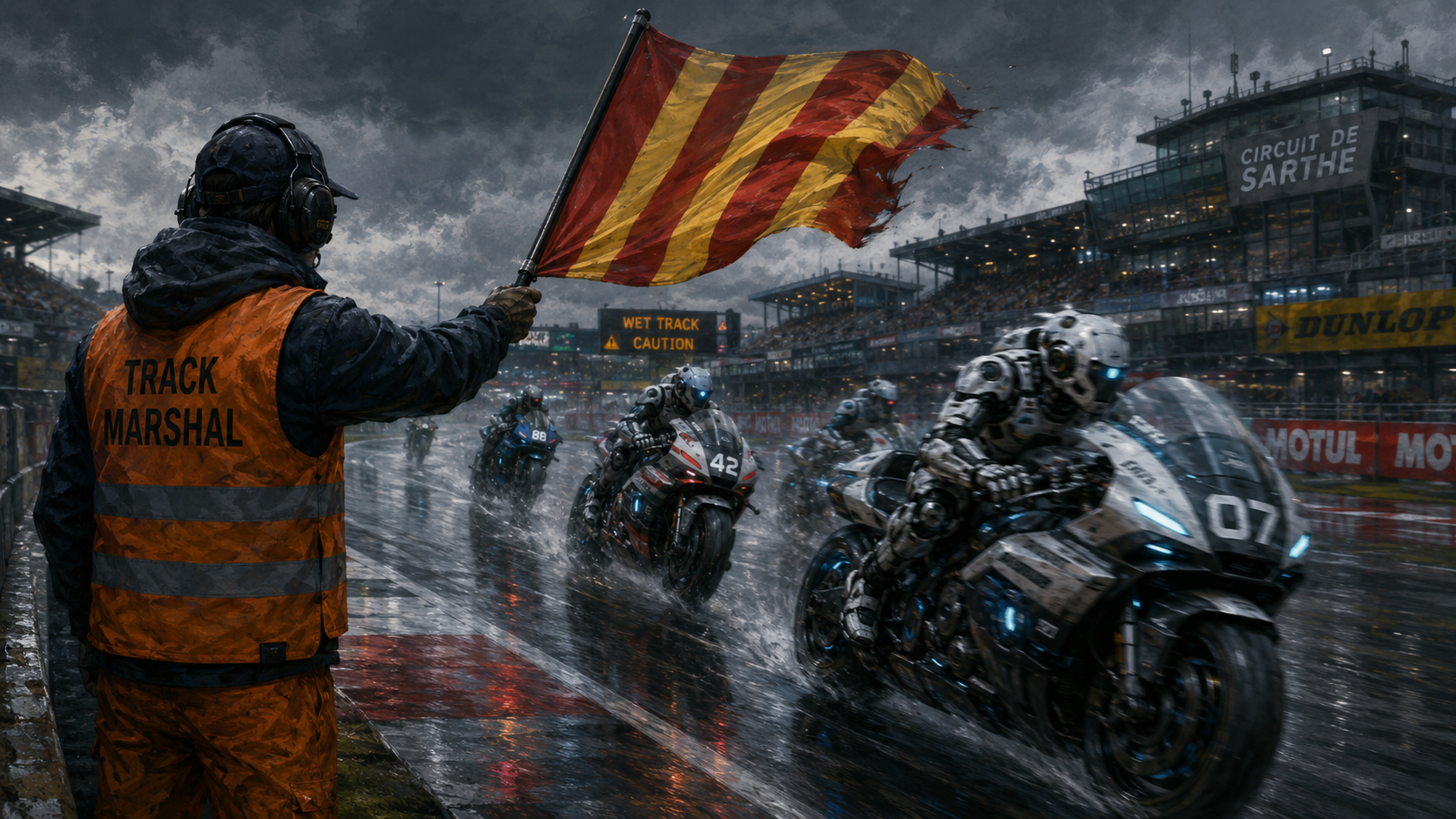
Developers now wear orange
Those who know me knows I am involved as a track marshal… Track marshals are crucial for racers to go fast. They need to trust that we keep an eye on the track and warn them about any danger ahead. But we also report them to race control if they are not respecting the flags we wave.
In today’s software development, the agents are the racers. We, the analogue developers, owe it to them to build a safe track to race on, marshal them while they are braking late, leaning a bit too much, and take care of them when they highside.
I learned to develop on a 50 cc moped with nobby tires. My track was in the woods, trying to avoid all the trees. The developers of today will write a lot less code, but they will need to know how to manage a field of 1000 cc sport bikes on warm slicks. The interesting part is when it starts to rain on the agentic track. How do you show an agent the red and yellow striped flag?