
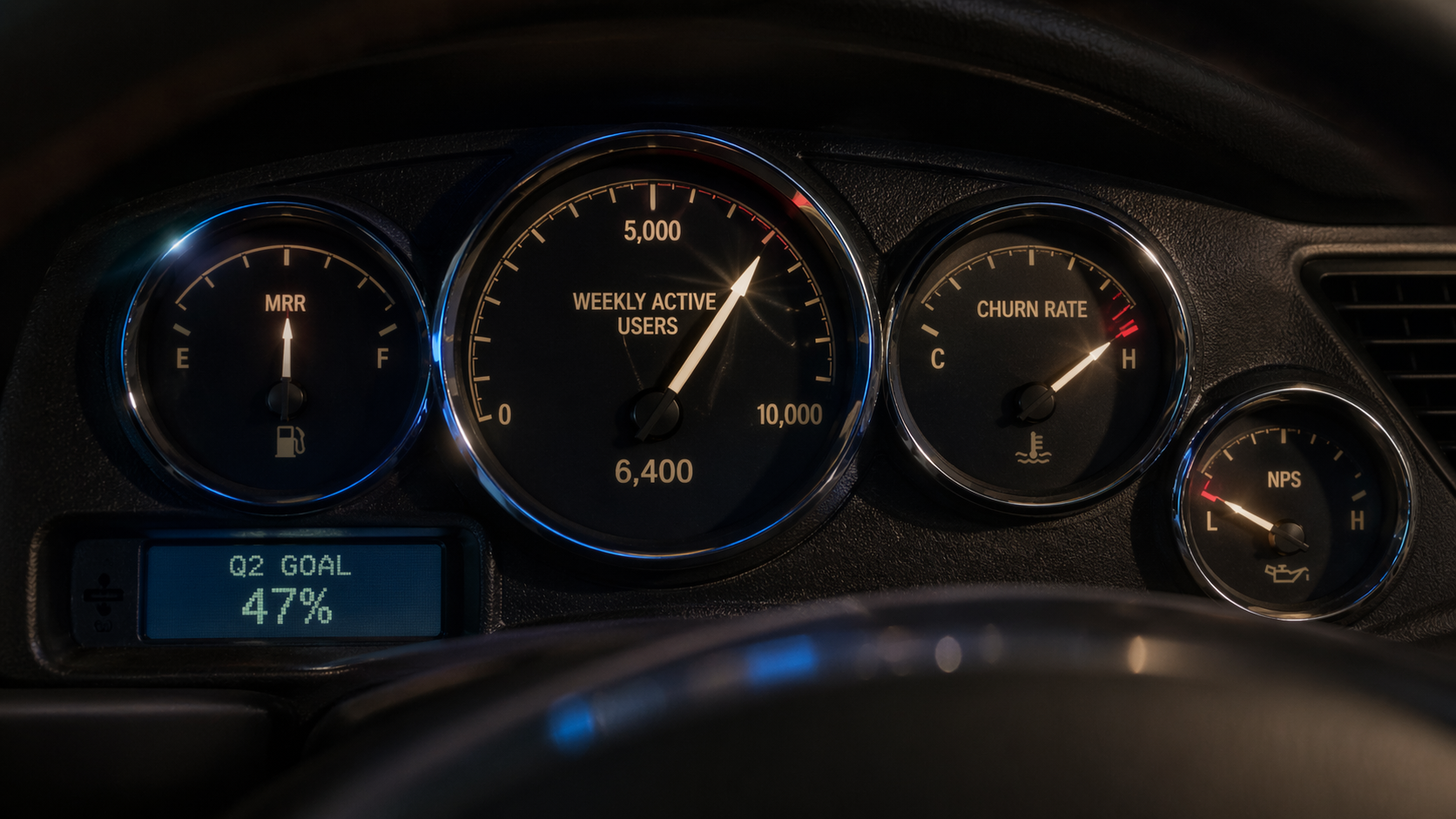
I was sitting in yet another goal-setting presentation last week. Slides. Fancy graphs. Ambitious numbers. “We want ten thousand active weekly users.” Applause. The room nods. The presentation ends.
And then I reached for DataDog.
Where is the dashboard? What is the baseline? How many do we have now? And while we are at it: what exactly counts as an active user? Is it someone who logged in? Someone who clicked something meaningful? Someone who accidentally opened the app while looking for Spotify?
Blank canvas. No dashboard. No funnel. No baseline. Just a beautiful empty screen waiting for someone to care enough to build it.
My first reaction was not “great, let’s go!”. My first reaction was that I was staring into the dark void of silence, and the dark void of silence was not going to tell me anything useful.
The goal without a gauge
There is a pattern I see absolutely everywhere and it drives me completely nuts.
Goals are set. Goals are communicated. Goals are applauded. Goals are put into a slide deck. And then it is a gap. Until the next presentation of new goals, where the results of the previous ones are quietly acknowledged in one slide before we scroll on to the exciting new ones.
But in the gap… Just the dark void of silence, doing its thing.
Nobody knows if we are ahead or behind. Nobody knows if what they shipped last sprint moved the needle or not. You could be winning spectacularly or losing catastrophically and your Tuesday afternoon would look exactly the same.
Execution starts with visibility. So why do we keep building the car without the dashboard?
The cost of disconnect
If the speedometer is broken when I am driving, I feel uncomfortable. I do not want to get caught by men in blue and fined, so I either slow down to a speed I know is safe, meaning slower than necessary. Or I start Google Maps and get the GPS speed from there. A workaround. Lag and friction, because the built-in instrument is not working. And I had to stop roadside to start the GPS, since I never drive and use my phone at the same time. ;)
That is exactly what engineers and teams do when they cannot see the company goals in real time. They slow down. They guess. They optimise for what they can measure, which is usually not what the company is actually trying to achieve. They pick their own speed.
And here is the really painful part.
When I read posts about top performers getting cut from companies they have worked for over many years, loyal people, capable people, I think those are symptoms of this exact disconnect. They were performing. Just not towards the goals of leadership, because they could not see those goals. Not in any living, breathing, day-to-day way.
I don’t think they did it out of stubbornness or ill faith. I think it happens because the ones doing the work cannot see how what they do connects to what matters. A direction is set. A measurable number is attached. And then it becomes less visible until the deadline approaches. By then, the relationship is already strained. The trust is already gone.
Communication builds awareness. Connection builds care. Without it, even the best teams will struggle to thrive. That is not management philosophy. That is just how people work.
When it actually works
Over the years I have had the fortune of working in places where this connection between goals and execution was visible and strong.
The first time was at a small company, where we had two physical whiteboards standing next to each other. The stakeholder goals on one, the development Kanban board on the other. Four stakeholders, ten developers, same building. Proximity did the work for us.
Another one was spread across the globe. I had stakeholders in 7 different timezoned. But there was exactly one Miro board shared amongst all of them, and every number was visible to everyone, always. Discipline did the work for us.
Neither of those solutions was expensive or clever. One was a whiteboard. One was a URL. What they had in common was that someone had decided visibility mattered, and then made it happen. Not next quarter. Not after the next planning cycle. Just: made it happen.
That is a decision, not a product feature.
Dear Santa…
I want to be more connected. I want to care and I want to be accountable. I also want to know that what I do matters. That is not a lot to ask.
My wishlist — applicable to anyone trying to fix this in their organisation — is pretty short:
- Show me how much closer we are to the financial goal this week. Not at the quarterly review. This week. Even a rough number. Especially a rough number, because a rough number updated frequently beats a precise number updated never.
- Make all goals measurable and SMART. “Release to all customers” is not a goal. It is a sentence. If you say it, tell me where the gauge is.
- Build a success channel. Post when milestones are reached. Not vanity-metric posts, real ones. “We crossed one thousand active users closer to our target.” Make it visible and make it normal to celebrate, because shipping features in silence is demoralising, and celebrating the wrong things is worse.
- Put the most important dashboards somewhere people actually look. Not in a Confluence doc that was last opened in February. Somewhere people look.
I don’t just want to see my speed. I want the water temperature, the fuel gauge, and the outside temperature too.
Give them the dashboard and they will drive.
